Production Planning
How Do You Choose the Right Clothing Manufacturer for Your Brand?
Three factories say they can make your collection. Their prices differ. Their samples look convincing. Here is how to choose a clothing manufacturer using evidence before sampling, bulk production and repeat orders.
Short Answer
Choose a clothing manufacturer in three stages: check product experience and commercial fit before paying for samples; approve the garment, costs and production controls before ordering bulk; then assess the delivered goods before reordering. Give shortlisted suppliers the same brief and ask for evidence behind their answers. A low price or a good sample cannot resolve uncertainty about who will make your order, what you will receive or when it will arrive.
Who deserves a sample order?
The first decision is whether a supplier is worth spending development time and money with. You need enough evidence of product capability, a workable order size and a clear scope of support.
Can they make your particular garment?
Ask to see work that resembles the product you intend to sell. A portfolio of basic T-shirts provides limited evidence of experience with lined leather jackets or close-fitting stretch leggings.
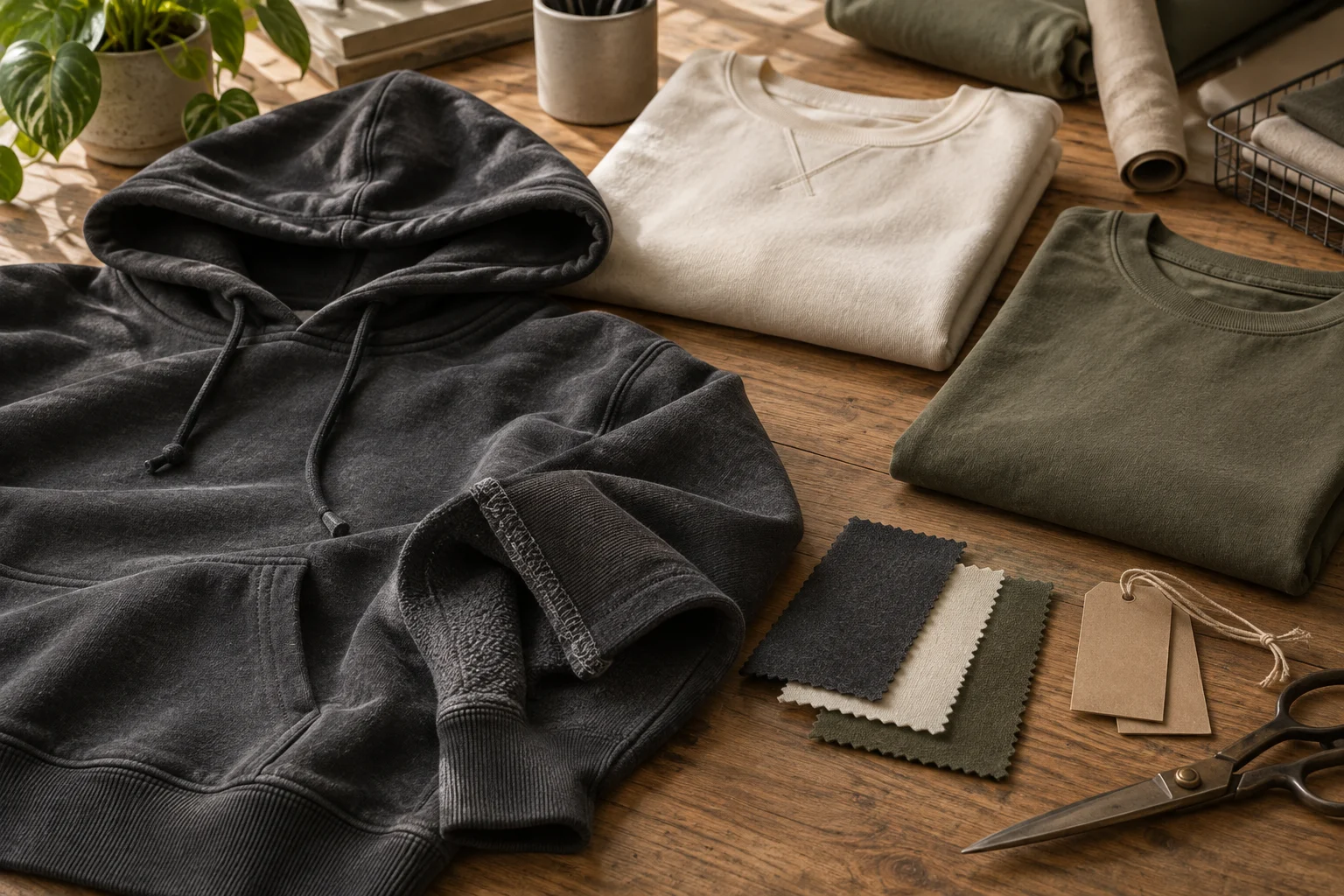
For a heavyweight hoodie, discuss hood construction, rib cuffs, pocket finishing and decoration. Request representative samples or close-up construction photographs. Ask: “Which part of this garment is most likely to cause difficulty, and how would you address it?”
A useful answer identifies a specific issue and how to investigate it. For example, a supplier might propose testing your embroidery on the selected fabric before approving its placement. Check the result during development.
Are you asking each supplier to quote the same job?
Send a consistent brief covering product type, reference images, material preferences, fit, quantities by colour and size, decoration, packaging, destination and required arrival date. State what is undecided.
A tech pack is the document recording the garment's specifications. Our factory-ready tech pack guide explains what belongs in it. If you need patterns or specifications developed, ask who will create them, what it costs and what files you receive.
Does the minimum fit the collection you can afford?
Minimum order quantity, or MOQ, is the smallest quantity accepted under particular conditions. Ask whether it applies per style, colour, fabric or overall order.
A hypothetical minimum of 150 pieces per style and colour would require 450 pieces for one style in three colours. Separate fabric or trim minimums may also apply. Request a written breakdown using your actual collection, including charges for unused materials.
Our MOQ and lead-time planning guide explains these trade-offs.
Who will actually make the garments?
Establish whether you are dealing with a factory, sourcing company or business coordinating several facilities. Ask where production will happen, which work goes elsewhere and who is accountable for quality and corrections.
Cross-check the business identity, production address and company named on the quote. A live walkthrough or independent visit can help investigate capability. Clarify unexplained differences before paying.
Move to sampling when: relevant capability is supported, the proposed quantity and budget work, and the sample scope, fees, revisions and responsibilities are documented.
Who deserves a production order?
Sampling lets you evaluate both the garment and the working relationship. Watch whether the supplier understands corrections, flags conflicts and delivers what was agreed. Quick replies are useful; accurate follow-through is more revealing.
Does the sample prove what you need it to prove?
An early sample in substitute fabric cannot confirm the finished garment's final feel or behaviour. Agree which development stages are needed and what each one approves. Our apparel sample types guide explains the differences.
Measure against the specification using consistent methods, review fit and movement, and inspect construction, trims and decoration. Record changes with photographs, measurements and a version reference.
Agree relevant wash or performance checks and acceptance criteria. For a wash comparison, use consistent conditions and retain an unwashed reference; the fabric shrinkage guide explains what to record.
Before bulk approval, identify the final reference sample, material specification and written instructions. Record any exceptions and confirm how the production team receives the approved version.
How do you compare quotations fairly?
Send each shortlisted supplier the same brief and ask it to list assumptions, inclusions and exclusions. An incomplete quotation should remain an open question, not become the cheapest option by default.
Compare material specifications, construction, decoration, labels, packing, development fees, inspection arrangements and delivery scope. Record the currency, quote validity, payment milestones and any conditions that can change the price.
The following example is illustrative, not market pricing or an S & H Global quotation. Both suppliers are assumed to meet the same specification and delivery scope.
Supplier A's garment price is lower, but Supplier B's subtotal is lower after these additional costs. Neither subtotal is a complete landed cost: add any applicable duties, taxes, insurance, inspection and other charges before making the final comparison. Landed cost means the total cost of getting goods to the agreed destination.
If a quote uses an Incoterms® rule, record the rule, named place and version. These rules allocate specified delivery responsibilities, costs and risks between buyer and seller; a garment price alone does not explain that allocation. See the International Chamber of Commerce explanation.
Illustrative quote comparison for 300 garments
Illustrative USD amounts only. Both suppliers are assumed to meet the same product specification and delivery scope. Subtotals exclude any additional duties, taxes, insurance or inspection costs.
| Cost for 300 garments | Supplier A | Supplier B |
|---|---|---|
| Garments | $2,700 | $3,000 |
| Labels and packing, charged separately | $180 | Included |
| Development | $240 | $120 |
| Delivery to the same destination | $480 | $330 |
| Subtotal of listed costs | $3,600 | $3,450 |
| Subtotal per ordered garment | $12.00 | $11.50 |
What will happen if production falls short?
“We check quality” is too broad to evaluate. Ask what gets checked, when it gets checked, who records the result and what happens after a failure.
For your order, document:
Material checks: identity, colour and agreed characteristics before use.
Production checks: construction, measurements and decoration while corrections are still practical.
Shipment checks: finished garments, quantity, labels, packing and agreed defects.
Failure handling: who reviews the finding, authorises corrective work and confirms the result before release.
Independent inspection can provide another source of evidence. QIMA describes inspections at initial production, during production and before shipment, with sampling selected independently at the factory. These stages answer different questions; agree the scope that fits your order. See QIMA's product inspection guidance.
If a supplier proposes an acceptance sampling plan, ask it to explain the sample size, defect categories and pass/fail rules. Inspecting a sample is not a promise that every shipped garment is defect-free.
Agree the proposed correction, reinspection and release process in writing, including responsibility for associated costs. Do not assume that a remake, refund or credit will happen automatically.
Do certification claims hold up?
Ask which claim the certificate supports, who holds it, whether it is current and whether its scope covers the relevant product or material. Verify through the issuing organisation where possible.
For example, OEKO-TEX® STANDARD 100 concerns textiles tested for harmful substances. Its official page directs buyers to check certificate numbers or label QR codes. It should not be treated as evidence of every environmental or labour claim a supplier might make. See OEKO-TEX's explanation and verification guidance.
Does the schedule end when you need the goods?
Ask what starts the quoted lead time. It might begin after the deposit, material receipt, sample approval or completion of several conditions. Record which applies.
Work backwards from the date goods must arrive. Include development, revisions, material sourcing, production, inspection, any corrective work and transportation. Distinguish the factory's ready-to-ship date from arrival at your warehouse.
What does a useful supplier answer sound like?
These hypothetical exchanges show the detail to request. A well-written answer still needs supporting evidence and follow-through.
Move to production when: the final product is approved, the quote has a defined scope, delivery milestones are realistic and quality checks and issue-handling terms are agreed. Unresolved material questions should remain visible rather than disappearing into a general approval email.
Supplier answers: what to clarify
Hypothetical examples. Written answers still require supporting evidence and follow-through.
| Topic | Answer that needs a follow-up | More useful answer |
|---|---|---|
| Timing | “Production takes four weeks.” | “Our proposed four-week production window starts after final sample approval and material receipt. Transport is additional. We will confirm dates against available capacity.” |
| Materials | “Bulk will be the same.” | “We will record the approved fabric reference and specification. Any proposed substitution will be submitted for written approval before use.” |
| Quality | “Every order passes quality control.” | “Here is the proposed inspection scope and report. Let us agree defect criteria, release responsibility and the correction process before production.” |
| Price | “Everything is included.” | “This quote lists garments, decoration, labels and packing. Development and delivery are separate, as shown.” |
Which gaps are negotiable, and which should stop an order?
A missing service can be manageable. An unresolved question about identity, product conformity or accountability is a reason to pause. Use the distinction below before comparing prices.
For each shortlisted supplier, mark product, quantity, cost, quality, timing and accountability as supported, needs clarification or unacceptable. Beside every open point, record the evidence needed, the person responsible and the deadline.
Which gaps should stop an order?
Suggested buying decisions; assess each finding against your actual order requirements.
| Finding | Suggested response |
|---|---|
| The factory does not create tech packs | Proceed only if you can arrange development elsewhere and the factory accepts the completed specifications. |
| The MOQ is too high | Discuss fewer colours, another material or a different supplier. Do not assume a smaller order will be accepted. |
| The first sample needs corrections | Continue development if the problems and correction plan are clear. Withhold bulk approval until the agreed requirements are met. |
| The supplier will not identify where production happens or who is responsible | Pause the order until you have sufficient, verifiable information. |
| Payment instructions suddenly name an unexplained recipient | Pause payment and independently verify the change through an established contact channel. |
| The supplier insists on bulk approval despite unresolved material or measurement failures | Withhold approval. If it will not correct the problems or agree an acceptable specification, choose another supplier. |
| A required certificate cannot be verified for the relevant scope | Do not rely on the claim. Resolve it before committing to an order that depends on it. |
Who deserves a repeat order?
Your first delivery provides evidence that sampling alone cannot. Where practical, start with a manageable production commitment and assess the result before increasing volume.
Compare what arrived with the approved reference and order records. Check whether quantities and the size breakdown are correct, whether quality requirements were met and whether the delivery matched the agreed milestones. If issues occurred, record how quickly they were acknowledged and whether the agreed remedy was completed.
Our guide to bulk orders that do not match the approved sample explains how to document a mismatch. Keep that record alongside inspection reports and supplier correspondence so the next buying decision reflects the whole order.
Consider a hypothetical supplier that uses unapproved fabric in bulk. A discount alone does not prevent recurrence. Before reordering, seek an explanation, an agreed resolution and evidence of how material approvals will be controlled.
Before a repeat order, reconfirm material availability, price, minimums and capacity. Identify any changes to the specification or production arrangement. Previous success is useful evidence, but it does not confirm the conditions for a new order.
Reorder when: the delivered product and the supplier's handling of the order justify another commitment, and the next order's terms are confirmed. Increase volume according to the evidence you have gathered.
What should you send a shortlisted manufacturer?
Use this inquiry to request comparable information. Replace the brackets and attach your available specifications; leave undecided details clearly marked.
Hello [name],
We are developing [garment] for [intended customer/use]. Our planned order is [quantity], split across [colours and sizes], for delivery to [destination] by [required arrival date].
Attached are [tech pack/reference images/artwork]. We need help with [development, materials or other open details].
Please confirm your experience with comparable garments, where production would take place and which processes would be handled elsewhere.
Please quote the sample scope, fees, included revisions and estimated timing. For production, please state the minimums by style, colour and material, and itemise what the price includes and excludes.
Please explain what starts the production lead time, the proposed quality checks, how material substitutions are approved and how production issues are handled. Include payment milestones, quote validity and delivery terms.
Please flag any part of our brief that needs clarification before you can provide a reliable quotation.
If you are considering S & H Global, review our apparel and leather garment manufacturing services and share your brief, quantity breakdown and target arrival date to discuss the support your collection needs.
Related resources
Continue planning
- factory-ready tech pack guide Explore factory-ready tech pack guide.
- MOQ and lead-time planning guide Explore MOQ and lead-time planning guide.
- apparel sample types guide Explore apparel sample types guide.
- fabric shrinkage guide Explore fabric shrinkage guide.
- bulk orders that do not match the approved sample Explore bulk orders that do not match the approved sample.
- apparel and leather garment manufacturing services Explore apparel and leather garment manufacturing services.
Read next