Product Development
Why Does Your Clothing Sample Cost So Much More Than the Bulk Price?
The sample quote arrives, and one hoodie costs far more than the proposed bulk unit price. Before judging the fee, find out whether you are paying for a garment, its development, or both.
Short Answer
A clothing sample can cost much more than a bulk unit because the quote may include development and setup work as well as making one garment. In bulk production, repeat operations and shared setup can reduce the cost per piece. The size of the difference depends on the product, what already exists and what the quote includes; there is no universal sample-price multiplier. Ask for the scope, revision terms, delivery costs and any production credit before deciding whether the fee is reasonable.
Why is one sample not priced like one bulk garment?
The supplier quotes a bulk unit price, then sends a much higher figure for a single sample. It can feel as though the same hoodie has suddenly become a different product. But the two quotes may be paying for different amounts of work.
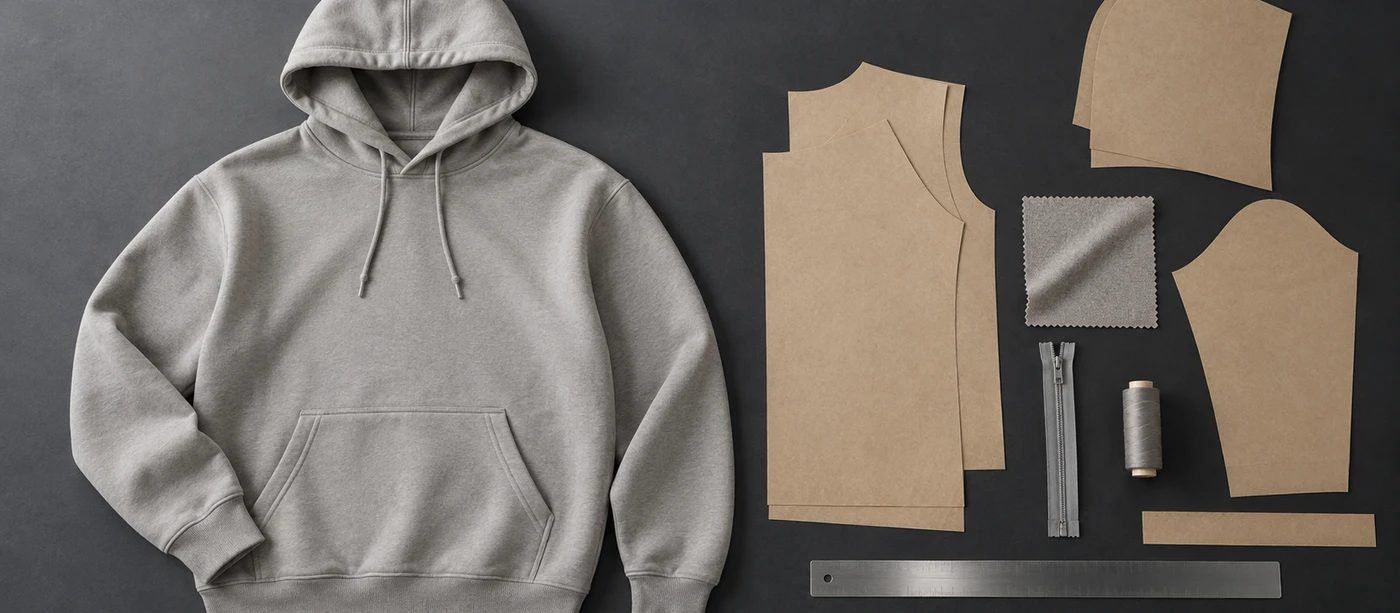
This is why clothing samples cost more than bulk in many custom projects: the first garment helps establish how the product will be made. A pattern may need to be developed, materials selected, construction details resolved and the finished result checked against the brief. A repeat garment can use decisions and instructions that already exist.
That explanation is a starting point, not a reason to accept any price. Ask the supplier to identify the work in your particular quote. If you are ordering an existing blank with a small print, a fee for complete garment development needs a clear explanation. If you are developing a new shape and construction, comparing the fee with a ready-made hoodie misses part of the job.
What are you actually paying for in a sample quote?
A useful quote separates the deliverable from the work needed to produce it. The deliverable might be one fit sample in one size. The work might include a new pattern, material sourcing, decoration preparation and a defined correction round. Other suppliers may price these items separately.
A pattern is the set of shapes used to cut the garment pieces. Trims are components such as zippers, buttons and labels. A tech pack is the written product specification containing the measurements, materials, construction and artwork information. Clarifying these items helps you understand what the supplier has to create and what you are already providing.
For example, the breakdown below shows how one hypothetical hoodie sample could total US$230. All numbers in this article are invented teaching examples in US dollars, not market averages or S & H Global prices. Actual charges depend on the agreed scope.
Example: what could make up a $230 sample invoice?
Illustrative USD amounts only. Assumes one sample, no revision round, and no taxes or import charges.
| Item | Example cost |
|---|---|
| Pattern development | $80 |
| Fabric and trims | $35 |
| Cutting, sewing and finishing | $45 |
| Decoration setup | $25 |
| Measurement and review | $15 |
| Courier | $30 |
| Total | $230 |
Questions that make sample quotes comparable
Potential charges vary by supplier and project. This is a comparison guide, not an S & H Global price list.
| Possible charge | What it may cover | What to confirm |
|---|---|---|
| Pattern and development | Turning the specification into cuttable shapes and resolving construction | Is a new pattern included, or is an existing fit being used? |
| Materials and trims | Fabric, rib, lining, closures and labels for the sample | Are these the intended production materials or temporary substitutes? |
| Sample making | Cutting, sewing, finishing and checking the garment | Which sample stage, size and quantity are included? |
| Decoration setup | Preparing artwork for the chosen print or embroidery process | Are setup and trial pieces included or billed separately? |
| Revisions | Agreed changes or further sample rounds | Which corrections are included and which changes cost extra? |
| Delivery and other charges | Courier, packaging and any separately quoted charges | What is the total payable, and what remains excluded? |
How does bulk production change the cost per piece?
Once the product is settled, production can repeat the same cutting, sewing and finishing operations across a run. Some preparation can serve multiple garments rather than a single sample. Material purchasing and scheduling may also differ between a development piece and a confirmed production order.
In a separate simplified example, assume a one-time setup costs $100. Assigned to one garment, that is $100 per piece; shared across 100 garments, it is $1 per piece. Fabric, sewing and other costs still sit on top. This explains the arithmetic, not a guaranteed bulk discount: the setup must actually be reusable, and it should not be charged again if already paid for.
However, not every charge disappears. Fabric, trims, labour and finishing still have costs. Some development expenses may remain separate; others may be included in the bulk price. Ask which items are already paid for and how the final production quote treats them.
Also check the quantity behind the quoted unit price. A price for a larger order is not automatically available for your smaller first run. Our MOQ and lead-time planning guide explains how minimum order quantity, the smallest order accepted under the quoted conditions, can depend on the product and materials.
Why do quotes for similar-looking samples vary so much?
Two garments can look similar in a reference image while requiring different work. One supplier may have a suitable existing pattern and available fabric. Another may be quoting a new pattern, specially sourced material and a custom finish. The final photograph alone does not reveal that difference.
Ask each supplier to quote the same written brief, sample stage and delivery destination. Make substitutions visible: an available fabric used only to assess fit is not the same deliverable as a sample made with the intended bulk material. Either may have a purpose, but you need to know which question the sample will answer.
Published supplier terms illustrate why inclusions matter. Create Fashion Brand lists sample development and print or embroidery opening costs separately, with other development items potentially charged separately too. That is an example of one supplier’s structure, not an industry price rule or an S & H Global policy.
What if you already have a pattern?
Tell the supplier what format it is in, which size it covers and whether it has been tested in the intended fabric. Ask whether the factory can use it as supplied or needs to check or adapt it. Having a file can reduce some work, but it does not establish that all development has already been completed.
What if you only need a print sample?
Specify whether you need artwork tested on a fabric piece, decoration on an existing blank, or a complete custom garment. These answer different questions. If placement and fit are important, a print test alone may not be sufficient for final garment approval.
How do you tell whether a sample fee is reasonable?
Start with a written description of the service and result, then compare equivalent proposals. A low headline fee can become less attractive if material sourcing, delivery and each correction are extra. A higher fee may include more work, but the supplier should explain that scope before you pay.
Consider two hypothetical quotes for the same sample and one physical revision. Quote A starts at $120, then adds $40 setup, $60 for the revision and $30 total courier: $250. Quote B is $210 including those same items. Under these assumptions, B costs $40 less despite its higher headline price. Confirm that materials, workmanship and revision scope are also comparable.
Look for a clear deliverable, relevant examples of work and a credible explanation of the development process. Ask what happens if the sample differs from the agreed instructions. A high price does not prove craftsmanship, and a low price does not prove a problem.
If the supplier cannot explain what is included, resolve that uncertainty before comparing the number with a bulk price. You need enough information to assess the purchase, even if the supplier does not disclose its internal labour rates or margin.
Why should revision terms be agreed before the first sample?
After receiving a sample, you might ask for a shorter body, a different pocket and a new fabric. Those are design changes. A sample made with the wrong approved fabric or a missed measurement instruction raises a different question. Agree how the supplier distinguishes changes to the brief from corrections to its work.
Ask how many rounds, if any, the fee covers and what each round includes. Does a revision mean updated measurements, photos of a correction, or another physical garment delivered to you? Who pays for material changes and the next courier shipment? Avoid relying on the phrase “revisions included” without those details.
Keep comments specific and together in one current version. The factory-ready tech pack checklist helps organise the information that a supplier needs. Clear comments can reduce avoidable back-and-forth, although they cannot guarantee that every design will be right in one round.
Before requesting another sample, identify what the next round must prove. The guide to apparel sample types explains the different roles of development, fit, size-set and pre-production samples. Paying for another garment is more useful when you know which approval it supports.
What does a sample fee credit actually mean?
A supplier may offer to apply some sampling charges against a later production order. Treat that as a specific commercial term to confirm, not an automatic entitlement or a promise that the whole development process becomes free.
For a separate credit example, assume you already paid $230 for sampling. A later order of 200 garments at $18 each totals $3,600. If the written offer credits $100 of the sample fee, the production invoice becomes $3,500. Combined sample and production spend is $230 + $3,500 = $3,730, before any additional freight or taxes. The remaining $130 of sampling cost has not been refunded.
Confirm which charges qualify for the credit, the required order conditions and where it appears on the invoice. Courier, revisions or setup may be excluded.
Compare the complete production proposal before committing. A credit is not a good reason to buy more garments than the launch can justify. Our article on launching without too much stock explains how to evaluate that first order against demand and available cash.
Also ask what files and physical materials you will receive or be able to reuse. Paying a development invoice does not by itself tell you whether pattern files, decoration files or tooling are included for transfer. Get the proposed access and handover terms in writing rather than making assumptions.
What should you confirm before paying a sample fee?
You do not need a long negotiation for every sample. You do need a shared understanding of what you are buying. Send these questions with the final brief and keep the answers alongside the quote.
- What sample stage, size and number of garments does the price cover?
- Is the garment based on an existing pattern or new development?
- Which materials and trims will match bulk production, and which are substitutes?
- Are decoration setup, labels and any agreed tests included?
- What revisions and corrections are covered, and what triggers an extra fee?
- What is the full payable amount including delivery and stated exclusions?
- What must be confirmed before work begins, and what timing is proposed?
- Is any fee credited against production, and under which written conditions?
- What pattern, artwork or other development files are included in the handover?
How can you control sampling costs without skipping useful work?
Reduce unnecessary uncertainty before paying for development. Settle the intended fit, main material, construction and decoration requirements as far as you reasonably can. If a choice is unresolved, explain that and ask which development step would help you decide.
Keep the first range focused. Developing several colours or styles at once can make it harder to see which decisions are driving extra rounds. Where appropriate, ask whether a material swatch or decoration trial can answer a narrow question before you commission another complete garment.
Do not reduce the sample scope so far that it no longer tests the product you intend to sell. A substitute fabric may help check an early shape but may not show the final drape or wash behaviour. Record those limits and confirm the final production reference before bulk approval.
The useful outcome is a sample you can evaluate, a clear record of remaining changes and a bulk quote based on the agreed product. If you are preparing a custom garment with S & H Global, share your product brief so the sampling scope can be reviewed alongside the manufacturing requirements. Project-specific charges and terms need to be confirmed in the quote.
Frequently asked questions
Why is a second sample sometimes charged separately?
The original quote may cover only one round, or the next sample may involve changes to the design, materials or decoration. Ask whether it is a new development request or a correction to the agreed brief, and confirm the applicable terms before work starts.
How much more should a sample cost than a bulk unit?
There is no universal multiplier. The comparison depends on the development scope, sample type, materials, decoration, delivery and the quantity behind the bulk quote. Compare written inclusions rather than judging by the ratio alone.
What if the sample looks good but the bulk quote increases?
Ask which assumptions changed and request an updated quote for the final specification and quantity. A preliminary estimate may not cover decisions made during development. Confirm the production price and its inclusions before committing to the order.
Related resources
Continue planning
Read next