Product Development
How Do You Develop a Retro Track Jacket for Your Clothing Brand?
Turn a retro track-jacket reference into a clear product brief, with practical decisions on fabric, panels, fit, trims and sample approval.
Short Answer
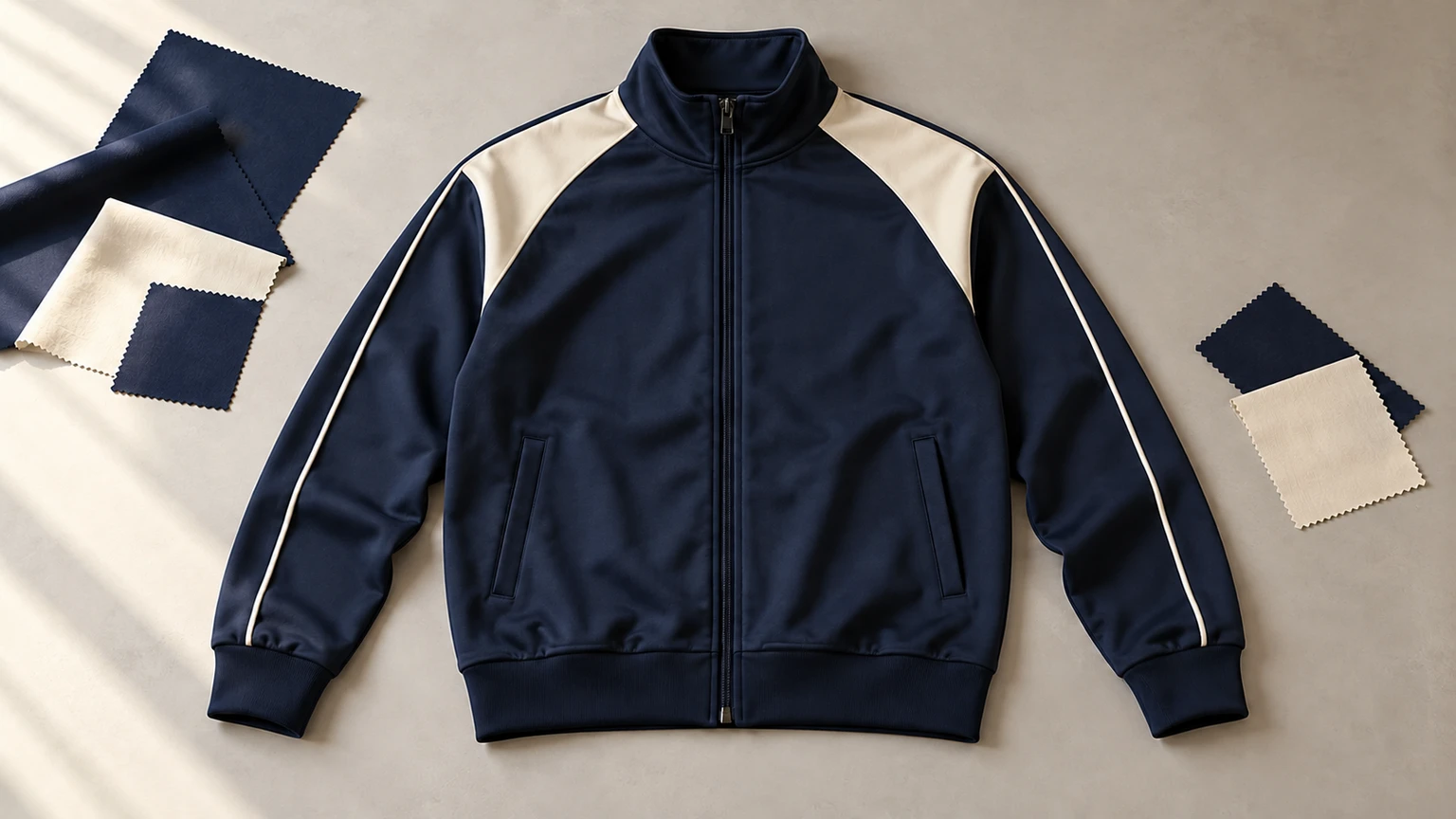
Develop a retro track jacket by turning the look into a measurable product brief, selecting fabric for its intended use, and testing the complete sample before approving production. Record the fit, panel shapes, collar, zipper, pockets, cuffs and decoration in one current specification. A reference photograph can communicate the mood, but the approved garment and written details must define what the factory makes.
Why consider a retro track jacket now?
Retro sportswear gives clothing brands a familiar shape that can be adapted through colour, proportion and small construction details. A stand collar, contrast panel and clean zip front can carry the idea without filling the garment with decoration. The useful development question is which details make sense for your customer and price point.
There is a current market signal behind this direction. Depop’s September trend update, published on 9 October 2026, includes track tops among its featured choices for gym and yoga dressing. Its July trend review also highlighted tennis-inspired styles and vintage soccer jerseys. These are signals from one resale platform, not proof of demand for every new track-jacket collection.
Use that evidence to investigate a product, rather than to justify a large order on its own. Ask what your own customers would wear it with, where they would wear it and what they already buy. A fashion layer for everyday use and a jacket intended for training need different development decisions.
What should your first product brief explain?
Start with one intended use and one clear fit direction. Describe whether the jacket is a light layer over a T-shirt, a warmer casual piece or part of a matching set. Identify the customer, intended climate, size range, target selling position and estimated quantities by colour.
Choose a small set of references and explain the purpose of each. One might show the collar height, another the sleeve volume and another the colour blocking. Mark which details are fixed and which need the manufacturer’s suggestion. A collection of photographs without written decisions leaves room for conflicting interpretations.
A tech pack is the document that records how the garment should be made. Include front and back drawings, detail views, materials, measurements, construction notes, labels and packing instructions. Our factory-ready tech pack checklist explains the basic contents. Give each revision a date or version so sample comments refer to the same document.
Create your own panel arrangement and branding. A heritage reference can help explain a proportion or finish, but a recognisable team crest or another brand’s signature decoration should not become a substitute for your own design.
Which fabric suits the jacket you want to make?
Assess a physical fabric cutting before committing to a description such as shiny, vintage or premium. Record the fibre composition, construction, weight and finish, then check how it bends, stretches and feels against skin. The same colour and fabric weight can produce very different garments.
Fabric weight is often stated as GSM, meaning grams per square metre. It describes mass per area, not a complete quality grade. A heavier fabric may change drape and warmth, but it does not automatically improve colour retention, surface appearance or comfort. Our tracksuit fabric guide covers the wider material decision.
If contrast panels use a different material, assess the combination together. Look for differences in stretch, thickness, drape and behaviour after washing. Ask the supplier which checks are appropriate for the chosen fabrics and intended care method. Do not approve the shell in isolation and assume that every trim will behave the same way.
When should you consider a knitted fabric?
A knitted fabric is built from interlocking loops of yarn. Tricot is one type of knitted construction often considered for sportswear. Review the actual sample for the surface, body and movement you want; the construction name alone does not confirm stretch recovery or suitability for a particular activity.
When should you consider a woven shell?
A woven fabric is made by interlacing yarns. It may suit a lighter shell-style interpretation, depending on its construction and finish. Ask how the proposed fabric changes fit, lining and seam finishing. Do not describe the jacket as waterproof or windproof simply because the shell looks technical. Any performance claim needs appropriate supporting evidence.
How do you specify the retro details clearly?
Draw panel boundaries and show where they meet seams, pockets and the zipper. State the finished width of stripes or piping, which is a narrow decorative cord or folded strip sewn into a seam. Specify whether a stripe is a separate fabric panel, an applied tape or a printed detail, because these are different production instructions.
For the collar, record the finished height, shape and internal finish. Show how it sits when fully zipped and partly open. For rib cuffs and hem, identify the material and finished dimensions and review how firmly they hold the garment. Rib is a knitted structure commonly used at garment openings; its appearance does not prove that it will recover after stretching.
Specify a separating zipper for a fully opening front, along with its length, colour, puller and finish. Confirm pocket openings, pocket bags and whether pocket zippers are required. Check that the collar edges and horizontal panel lines meet as intended when the sample is closed.
Colour approval should include the assembled components. YKK’s zipper FAQ explains that zipper and garment colours can appear different under different lighting. Review the shell, panels, rib, zipper tape and embroidery together under agreed lighting conditions. A matching colour name is not enough to establish a visual match.
How should the sample fit and move?
Write down the measurements that control your silhouette: chest, body length, shoulder or sleeve construction, sleeve length, upper-arm width, cuff opening and hem opening. Define how each measurement is taken. A tolerance is the agreed acceptable variation around a target measurement; set it for your product rather than copying unexplained numbers from another specification.
Try the sample over the layer your customer is expected to wear. Close the zipper, reach forward, raise the arms and sit down. Observe whether the front pulls, the collar presses against the neck or the hem rides up more than intended. Record what happens and identify the relevant measurement or construction detail.
For example, “make it more vintage” leaves the correction open to interpretation. A clearer comment identifies the version, shows the area in a photograph and records the desired measurement or shape change. If the sleeve volume changes, review the cuff relationship and arm movement again instead of treating the adjustment as isolated.
Check more than the development size before approving a range. A size-set review compares samples in selected sizes to see how the approved design changes across the range. Our garment measurement tolerance guide explains how to keep measurement decisions consistent.
What should you check after washing?
Agree the intended care method before judging wash performance. Record the sample’s measurements and appearance before washing, use the agreed conditions, and compare the same points afterwards. Keep photographs and an unwashed reference where practical. The purpose is to evaluate the complete jacket under repeatable conditions.
Look for changes in body and sleeve length, twisting, puckered seams, zipper waviness, colour transfer between panels and changes to cuffs or decoration. Surface pilling means small balls of fibre forming on the fabric. If it matters to the product, agree how the surface will be assessed rather than relying only on a quick visual impression.
CottonWorks’ guidance on shrinkage and skewing explains why maintaining dimensions through laundering is an important product requirement. Its cotton guidance should not be treated as a test result for your polyester or mixed-material jacket. Ask for checks that match your actual construction and materials.
Agree product-specific acceptance criteria and any laboratory testing with the supplier before approval. A successful home wash of one sample does not establish every performance claim or guarantee that bulk materials will match. Our fabric shrinkage guide explains what buyers should record.
What needs approval before bulk production?
Bring the final sample, specification and material references together. Resolve open comments explicitly, including any substitution. If the sample contains temporary fabric, a different zipper or unfinished decoration, record what it cannot yet approve and obtain the missing evidence before releasing the affected work.
Keep development approval distinct from shipment checks. QIMA’s product inspection guidance describes checks at different production stages. Agree which checks your order needs, who records findings and what happens when something fails. An inspection cannot replace a clear product specification.
- Identify the final sample and current tech-pack version.
- Approve shell, contrast panels, rib, lining if used, and zipper references.
- Confirm fit, size measurements and agreed tolerances.
- Approve decoration size, placement and appearance on the actual fabric.
- Record wash findings, unresolved issues and required corrections.
- Confirm quantities, labels, packing, inspection arrangements and delivery milestones.
What should you send to start the conversation?
Send the intended use, reference images with annotations, available specifications, size range, quantity breakdown, destination and required arrival date. Identify which choices are already fixed and which need development. Ask for the sample scope, costs, revision arrangements and the conditions that start the production schedule.
If you are considering S & H Global, review our tracksuit manufacturing page and share that brief to discuss the product. Use the first conversation to establish whether the proposed fabric, construction and order requirements are workable. Confirm the details for your own jacket before committing to production.
Related resources
Continue planning
Read next