Product Development
How Garment Measurement Tolerances Work in Sampling and Production
A target measurement shows the intended garment dimension. A tolerance shows the permitted variation around that target. Both must be defined at every relevant point of measure before sample approval and bulk production.
What is a garment measurement tolerance?
A garment measurement tolerance is the allowed difference between a target measurement in the size specification and the measurement found on a sample or finished garment. For example, a body length target of 70 cm with a tolerance of plus or minus 1 cm permits a result from 69 cm to 71 cm, provided the garment is measured by the stated method.
A target without a tolerance is incomplete. Garments, fabrics, sewing operations and finishing processes create normal variation. The tolerance tells the sample room, production team and quality inspector what variation is acceptable at each named point of measure, or POM. It turns a size chart into a usable pass-or-fail production standard.
This garment measurement tolerance guide is intended for buyers preparing a tech pack, reviewing samples or setting the dimensional standard for bulk production. It does not replace fit approval. A garment can be within its listed measurements and still have the wrong balance, silhouette, neckline shape or visual proportion.
- Target measurement: the intended finished dimension.
- Tolerance: the accepted variation above and below that target.
- Point of measure: the named location and method used to take the measurement.
- Measurement result: the actual value taken from the garment under the specified condition.
Garment POMs are not body measurements
Body measurements describe the wearer. Garment POMs describe the finished product. A chest body measurement may help develop a size block, but it does not tell an inspector how to measure a finished T-shirt, jacket or trouser.
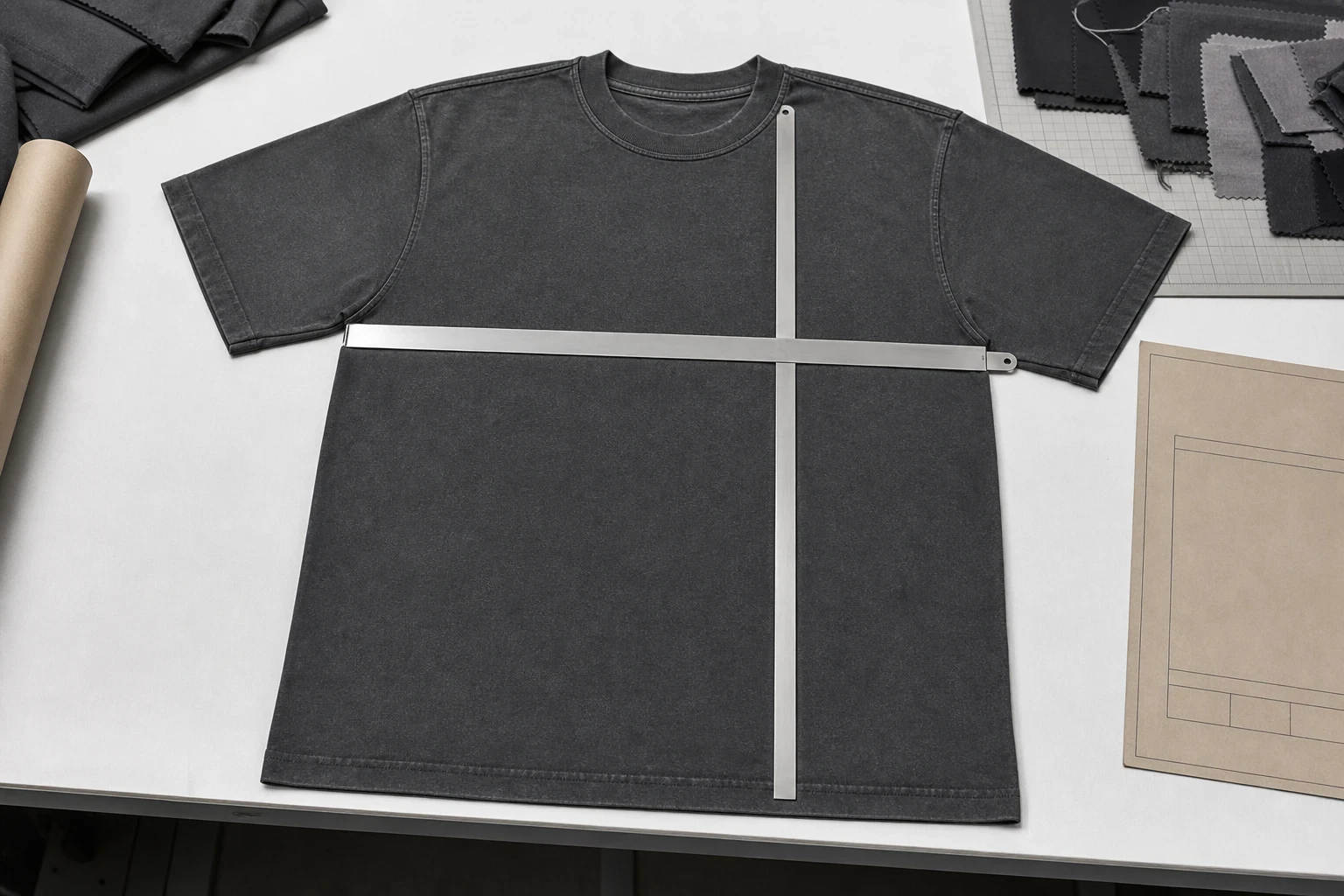
A product measurement specification should therefore name the garment location and condition. For a top, this may include chest width measured flat at a stated distance below the armhole, centre-back length from a named neck point, shoulder width, sleeve length and neck opening. For trousers, it may include waist measured relaxed, hip width, front rise, back rise, inseam, thigh and leg opening.
Use a POM diagram with arrows or clear measurement lines. Written names alone can be interpreted differently, especially when a garment has raglan sleeves, curved hems, shaped side seams, elastic, multiple panels or leather edge finishing.
Generic measurement-tolerance example
These figures are examples only. They are not S & H Global production standards or order requirements.
| Point of measure | Target | Tolerance | Example actual | Result |
|---|---|---|---|---|
| Chest width | 50 cm | ±1 cm | 50.5 cm | Within tolerance |
| Body length | 70 cm | ±1 cm | 71.5 cm | Outside tolerance |
Example T-shirt points of measure
Why a target measurement is not enough for sample approval
During sampling, a measurement sheet must answer two separate questions: what dimension is intended, and how much variation is allowed. Without both answers, comments such as “shorten the body slightly” or “make the waist smaller” can be interpreted differently by pattern, sample and quality teams.
The specification also needs the sample size. A target chest width is not useful if the reviewer does not know whether it applies to size M, size L or another base size. For a graded range, record targets and tolerances for every size, or clearly document the approved grade rules and the sizes that require physical review.
Before approving fit, compare the garment against the current measurement sheet, not an older sample or a conversation thread. The wider apparel manufacturing process should use one controlled version of the tech pack, POM diagram, measurement table and approval comments.
- Style name, style number or internal reference.
- Sample type, sample size, colourway and sample version.
- Units of measure, normally centimetres or inches, used consistently.
- Target value and plus/minus tolerance for each relevant POM.
- A clear method: flat or circumference, relaxed or stretched, and start and end points.
- Revision date and record of approved changes.
Within tolerance does not always mean approved
A garment may measure within tolerance but still need correction. A T-shirt can have an acceptable body length while its shoulder slope makes it look unbalanced. A jacket can meet chest and sleeve targets but have a collar shape, sleeve pitch or pocket position that is visually wrong. A stretch top can meet relaxed measurements but feel restrictive during movement.
Treat measurement compliance, fit, function and visual appearance as related but separate checks. Record the exact correction when fit or appearance is rejected. If the body length itself is correct but the front looks too long because of hem shape, the solution may be a pattern or hem adjustment rather than simply changing the length target.
How to set tolerances by point of measure
Do not apply one blanket tolerance to every POM. The suitable allowance depends on the garment type, construction, material behavior, measurement method and effect of variation on fit or appearance. A small change may be critical at a neck opening, pocket placement or artwork position but less significant at a long body measurement.
The buyer should decide which POMs are critical to the product. These often include dimensions that affect fit, matching between garments, component function or a visible design relationship. Marking critical POMs helps focus sample review and production measurement checks, but all listed POMs still need a clear target and tolerance.
There is no universal tolerance table that works for every style. Build the table around the approved product. A stable heavyweight jersey T-shirt, elastic-waist short, compression top, tracksuit with rib, technical woven trouser and leather jacket have different sources of variation.
- Fit-critical POMs: chest, waist, hip, rise, inseam, shoulder, sleeve and neck opening where relevant.
- Visual POMs: pocket position, placket length, collar point, panel width, stripe alignment and artwork placement.
- Component POMs: elastic opening, rib cuff, waistband, zipper length and pocket opening.
- Longer dimensions: body length, sleeve length, outseam and inseam.
- Construction-sensitive points: curved seams, shaped hems, gussets, leather panels and lined areas.
State the measurement condition
The same garment can produce different results if it is measured relaxed, stretched, laid naturally, pulled taut or after pressing. The condition must be stated in the spec sheet and followed consistently in sampling and inspection.
For a flat measurement, state whether the garment is measured across the width while laid flat and whether that value is doubled to calculate circumference. Do not leave the inspector to assume that a flat waist measurement means the same thing as waist circumference.
For stretch products, specify the relaxed condition first. If a stretched measurement or extension requirement matters, name the method, the starting condition and the defined stretch condition. Avoid vague instructions such as “stretch normally,” because different people apply different force.
- Elastic waist: measure flat and relaxed; separately define any required extension measurement if applicable.
- Rib neck opening or cuff: state whether it is measured relaxed, lightly laid flat or stretched.
- Compression garments: define the flat relaxed POM method and use functional fit review as a separate approval check.
- Knit garments: avoid pulling seams or distorting the fabric while measuring.
- Leather garments: state the exact panel edges and whether thickness, lining or seam construction affects the start or end point.
How tolerances change through sampling and bulk production
Tolerance requirements should be documented early, but the purpose of measurement review changes as the garment moves from development to production. A fit sample is mainly a pattern-development tool. A size set checks grading. A pre-production, or PP, sample consolidates the standard that bulk teams should follow. Bulk checks verify output against that approved standard.
At each stage, update the controlled measurement sheet when an approved change is made. Do not allow the fit sample, size-set sheet, PP sample and inspection checklist to use different versions. A sample room cannot reliably correct a pattern, and a quality control (QC) team cannot fairly assess bulk garments, if each team works from different targets or POM definitions.
For an overview of the sample sequence and the purpose of each approval, see the guide to apparel sample types.
Fit sample: establish the base-size pattern
Use the fit sample to assess the base size against the current POM sheet. Measure the garment, then assess it on a suitable fit model or form where possible. Focus on balance, ease, movement, proportions and the appearance of key components, not measurement compliance alone.
At this stage, a change may affect both the target measurement and the pattern shape. Record the requested target, POM method and reason. If a material substitute was used, note whether later review in the intended fabric is needed because stretch, shrinkage, drape or thickness can change the result.
Size set: verify grading across the range
Once the base size is approved, a size set checks that the graded sizes follow the approved measurement specification and keep the intended proportions. The chest, waist or length grade may be correct while a neck opening, pocket position, rise or sleeve proportion does not scale well.
Review the agreed sizes against their own targets and tolerances. Do not judge every size against the base-size measurement. If grading changes, issue a revised graded chart before bulk production.
PP sample and bulk: lock and verify the standard
The PP sample should bring together the approved pattern, measurement specification, materials, trims, branding, labels and finish. Its measurement record should be retained with the governing documents and the identified approved sample. This becomes the dimensional reference for production quality review.
During bulk production, measure against the approved specification and documented POM method. Where measurement checks are planned at different production stages, the buyer and manufacturer should agree the checkpoints and records for the order. The general workflow from approval to quality review is explained on the manufacturing process page.
Measurement tolerance is not the same as AQL
Acceptance Quality Limit (AQL) is a sampling-inspection approach used to assess a lot through selected units and defect classifications. It does not define what a garment chest, sleeve, waist or inseam is supposed to measure. Dimensional acceptance must come from the product measurement specification.
The tolerance table shows whether a point of measure is within its allowed range. An AQL plan explains how units are selected and how the inspected lot is assessed. A buyer may use both, but neither replaces the other.
If measurement deviations are found, the inspection record should identify the style, size, POM, target, tolerance, actual result, measurement condition and specification revision. This allows the team to investigate the correct pattern, cutting, sewing, pressing or finishing issue instead of relying on a general statement that the garment is out of spec.
- Use a POM and tolerance table to define dimensional requirements.
- Use an agreed inspection plan to define lot sampling and acceptance decisions where applicable.
- Keep the sample, spec revision and inspection report aligned.
- Do not treat an AQL reference as permission to omit measurement tolerances.
Measurement tolerance and AQL answer different questions
| Concept | Question it answers | Where the requirement comes from |
|---|---|---|
| Measurement tolerance | Is this garment measurement inside its permitted range? | The approved measurement specification |
| Acceptance Quality Limit (AQL) | How is a selected sample used to assess an inspected lot? | The inspection plan agreed for the order |
A buyer checklist before bulk approval
Before releasing bulk production, confirm that the dimensional standard is complete and matches the approved garment. This reduces late disputes caused by different measuring methods, old size charts or unclear sample comments.
A factory-ready tech pack should contain the point-of-measure (POM) diagram, measurement chart and bill of materials (BOM) alongside construction, artwork, label and packing information. Use the factory-ready tech pack checklist to review the wider document set. Material behavior also matters: shrinkage, stretch and recovery can affect finished dimensions, so keep the approved fabric standard connected to the garment specification. The fabric GSM guide explains why weight alone does not predict fabric behavior.
S & H Global supports custom, original equipment manufacturing (OEM), contract and private-label apparel and leather garment manufacturing. For a specific style, the final measurement method, tolerances, sample requirements and quality checks should be confirmed from the product brief and approved development documents.
- Current style, size range and base size are identified.
- Every relevant POM has a diagram, target, unit and plus/minus tolerance.
- Flat, circumference, relaxed and stretched conditions are clearly stated.
- Graded measurements match the approved pattern and size-set decisions.
- The PP sample and its measurement record are identified by version.
- The BOM, artwork, labels, packing instructions and measurement sheet use the same revision control.
- The production and QC checklist refers to the approved specification rather than an earlier sample.
Frequently asked questions
Should every garment point of measure have the same tolerance?
No. Tolerances should reflect the product, material, construction, measurement method and importance of the POM. A small variation may be unacceptable at a neck opening or pocket placement but less significant at a longer body measurement. Define the allowance for each relevant POM instead of using one blanket value.
What should happen when a sample is within tolerance but fits badly?
Do not approve it only because the measurements pass. Record the fit, balance, movement or visual issue separately and state the measurable correction needed. The target measurement may need revision, or the solution may be a pattern, seam, hem, collar or component adjustment.
How should elastic and stretch garments be measured?
State the condition in the specification. Usually this begins with a relaxed flat measurement. If extension matters, define a separate stretched measurement and a repeatable method. Do not use undefined instructions such as “stretch normally,” because results will differ between reviewers.
Which records should be retained with an approved production sample?
Retain the identified sample details, current POM diagram, approved measurement chart and tolerances, size and colourway, sample version, approval status, approved deviations, material and trim references, and the revision-controlled tech pack or production checklist.
Related resources
Continue planning
- Review the apparel manufacturing process See how approved specifications and samples guide bulk production, quality checks and packing.
- Understand apparel sample types Learn the different roles of proto, fit, size-set and PP samples before bulk approval.
- Use the factory-ready tech pack checklist Check the drawings, BOM, POM diagram, measurements, artwork, labels and packing details needed for development.
- Review fabric GSM and material behavior Understand why fabric weight should be reviewed with structure, stretch, shrinkage, recovery and finish.
- Explore the materials library Review current fleece, jersey, performance knit, technical woven and leather material examples.
- Discuss product development and sampling Share your tech pack, size specification, material requirements and sample plan with S & H Global.
Read next