Materials
What Is the Best Fabric for Tracksuits? A Buyer’s Guide
The best tracksuit fabric depends on whether the set is made for training, travel, warm weather, cold weather or casual wear. Compare the complete material, not its name or weight alone.
Short Answer
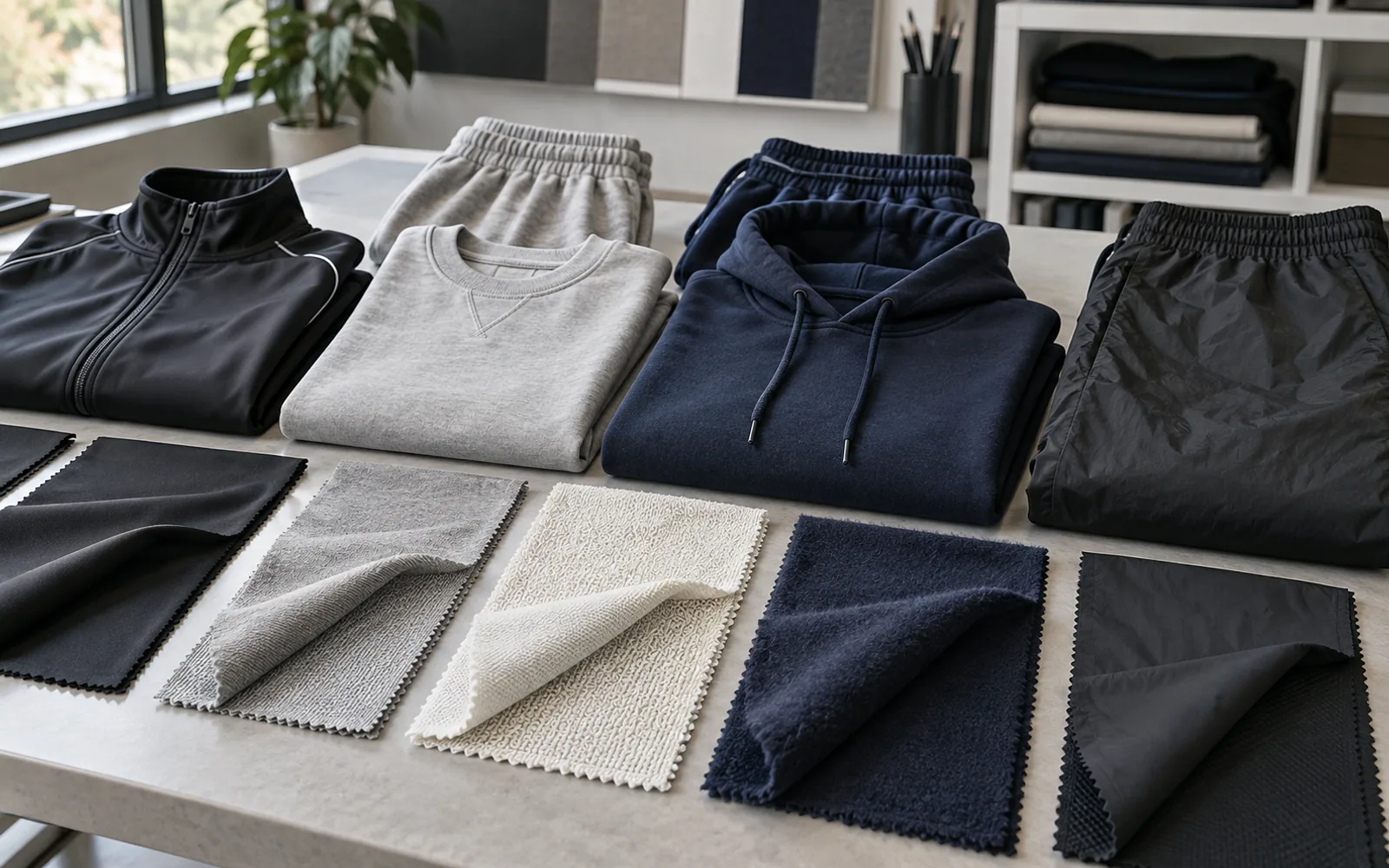
There is no single best fabric for tracksuits. Polyester tricot or a stable performance knit often suits sports and warm-up sets, French terry suits breathable casual and travel styles, brushed fleece suits colder weather, and a lightweight woven fabric can suit wind-resistant outer layers. Choose from the intended activity, climate, fit, feel and care needs, then approve the exact finished fabric in a complete tracksuit sample.
What should the tracksuit be designed to do?
The best fabric for tracksuits starts with the job of the garment. A training set needs freedom of movement, suitable moisture behavior and seams that remain comfortable during activity. A travel or leisurewear set may place more value on softness, shape, quiet movement and an easy-care surface. A cold-weather set needs insulation, while a warm-weather set needs lower bulk and comfortable airflow.
Write these requirements before choosing a fabric name. Define the activity, season, target climate, fit, inside feel, outside appearance, expected care and decoration method. Also decide whether the top and trousers should feel structured, relaxed or fluid. These choices give a manufacturer a useful product brief and prevent a familiar fabric name from becoming a substitute for the actual performance target.
The custom tracksuit manufacturing page shows the confirmed set formats, construction details and material examples that S & H Global can review. The commercial page explains the manufacturing service, while this guide focuses on the material decision itself.
How do common tracksuit fabrics compare?
Polyester tricot is a warp-knit fabric that often has a smooth face and a recognisable sportswear appearance. Warp knit means the loops are formed mainly along the fabric length by separate yarns. Tricot can work for classic warm-up sets, but its shine, snag resistance, airflow and inside finish vary. The buyer should review the exact construction rather than order from the word tricot alone.
French terry is a knit with a smooth outer face and unbrushed loops or floats on the inside. Fleece is related, but its inside is brushed or napped to raise a soft surface. CottonWorks describes this interior treatment as the main distinction between French terry and fleece. French terry usually gives a cleaner, less insulated inside, while fleece gives more loft and warmth. Fibre blend, yarn, density and finishing still change both materials.
Interlock and other double knits use two connected knit structures to create a more stable fabric than many single knits. They can be developed for stretch sportswear or cleaner lifestyle sets depending on fibre content and finish. Lightweight woven polyester or nylon can create a crisp travel or windwear tracksuit, but woven fabric normally stretches less unless its structure or composition is engineered for movement.
Is polyester or cotton better for tracksuits?
Neither fibre is universally better. Polyester can support durable, quick-drying and lightweight sportswear constructions. Cotton-rich fabric can provide a familiar soft feel and comfortable casual character, but untreated cotton generally absorbs more moisture and can dry more slowly. Blends can balance characteristics, yet the percentage alone does not reveal the knit, finish or garment result.
Tracksuit fabric options at a glance
These are general decision patterns. Composition, construction and finishing can change the result within every category.
| Fabric option | Often suits | Useful characteristic | What to verify |
|---|---|---|---|
| Polyester tricot | Warm-up sets and classic sports styling | Smooth face and a clean, sporty appearance | Snagging, shine, breathability, lining and after-wash appearance |
| Performance interlock or double knit | Training sets and structured sportswear | Stable surface with options for stretch and recovery | Movement, opacity, moisture behavior, pilling and seam compatibility |
| French terry | Travel, leisurewear and transitional weather | Smooth face with an unbrushed loopback interior | Shrinkage, loop regularity, recovery, drape and care response |
| Brushed fleece | Cold-weather and comfort-led tracksuits | Raised interior surface that adds softness and insulation | Pilling, shedding, shrinkage, bulk and warmth for the target climate |
| Lightweight woven polyester or nylon | Travel, wind-resistant shells and sideline sets | Low bulk and a crisp or technical appearance | Noise, airflow, water repellency claims, seam construction and lining |
Which fabric suits each type of tracksuit?
For a sports warm-up set, begin with a stable polyester knit such as tricot, interlock or another double-knit construction. Review how it moves, manages perspiration, resists snagging and works with the intended seams. Moisture management means how a material absorbs, spreads, transports and releases liquid moisture. It should be supported by testing for the exact fabric rather than inferred from the word polyester.
For a casual, streetwear or travel set, French terry or another cotton-rich knit can provide a softer look and a loopback interior without the raised pile of fleece. Its suitability depends on shrinkage, recovery, drape and the intended climate. Drape is the way fabric hangs and moves on the body. A relaxed silhouette may need fluid drape, while a boxier top and trouser may need more structure.
For cold-weather comfort, brushed fleece may be suitable because its raised inside surface traps more air and feels warmer. The sample should be checked for pilling, loose fibre, bulk at seams and whether the garment becomes too warm indoors. For a lightweight shell or travel set, a woven polyester or nylon may reduce bulk and offer a crisp appearance, but noise, breathability, lining and any water-repellency claim require separate review.
Does a higher GSM make a better tracksuit?
No. GSM means grams per square metre and measures the weight of a fabric area. It does not measure fibre quality, yarn quality, knit stability, softness, warmth, pilling resistance or colorfastness. A heavy fabric can still shrink, pill or recover poorly. A lighter fabric can perform well when its composition, construction and finish match the product.
Use GSM as one line in a complete specification. Review it with fibre composition, yarn, knit or weave structure, usable width, stretch, recovery, finish and intended use. The fabric GSM selection guide explains how weight changes warmth, drape, opacity and production decisions without treating heavier as automatically better.
The finished garment matters more than a number in isolation. Rib, waistband elastic, pocket bags, zippers, lining and decoration add their own weight and stiffness. A fabric that feels balanced as a swatch can become bulky at a zip, hood, cuff or pocket. Sample the complete top and trousers to see how all components behave together.
How do construction and finishing change the result?
Two fabrics with the same fibre composition and GSM can produce different tracksuits. Loop size, stitch density, yarn type and fabric structure influence stretch, surface appearance, stability and drape. Brushing changes the inside of fleece. Compacting can help a knit move closer to its relaxed dimensions. Heat setting can affect the stability of suitable synthetic and stretch materials. Every process should be confirmed for the actual material.
Stretch describes how far a fabric extends under force. Recovery describes how well it returns toward its original dimensions after that force is removed. A trouser knee, seat, elbow or cuff can grow during wear when recovery is weak. Stretch may also differ across the width and length, so the pattern and cutting direction need to match the approved fabric behavior.
Finishing can also change softness, surface friction, shine, water behavior and shrinkage. A finish name is not proof of performance. If quick drying, wicking or water repellency matters, agree how the claim will be evaluated. AATCC publishes separate textile methods for liquid moisture movement, wicking, drying and water resistance because these are different properties rather than one general idea of performance.
What should a buyer specify and approve?
A useful tracksuit specification identifies the fibre composition, fabric construction, finished GSM, color, finish, stretch direction and desired hand feel. Hand feel means the sensory impression when the fabric is touched and handled. Add the intended activity, climate, fit, care method and decoration so the material can be reviewed as part of the complete product rather than as an isolated swatch.
Define how the top and trousers must match. They may use the same main fabric, or the design may intentionally combine materials. In either case, confirm color appearance, surface, weight, stretch and care compatibility. Review ribs, elastics, pocketing, lining, drawcords and zippers alongside the main material. The factory-ready tech pack checklist explains how to record these choices clearly.
Approve decoration on the production-intent fabric. Screen print, embroidery and heat transfer can change how a surface stretches, drapes or feels. Dense embroidery may pull a light knit. Heat can mark or change some synthetic surfaces. A sample helps the buyer review appearance, placement, adhesion, puckering and comfort before bulk production.
Tracksuit fabric approval checklist
- Define the activity, season, target climate and expected wearing conditions.
- Record fibre composition, fabric construction, finished weight, color and finish.
- Describe the desired hand feel, drape, stretch, recovery and inside surface.
- Confirm the same fabric and color standard for the top, trousers and matching components.
- Review shrinkage, pilling, colorfastness and moisture behavior where relevant.
- Test print, embroidery or heat transfer on the production-intent material.
- Check seams, ribs, waistbands, pockets, zippers and lining with the selected fabric.
- Approve a complete sample after the agreed care procedure before bulk production.
How should the fabric be tested through sampling?
Begin with a physical swatch or fabric cutting, then move to a sample made from the intended material. A swatch helps compare face, reverse, color, thickness and hand feel. A complete sample shows fit, drape, seam behavior, pocket bulk, rib recovery and consistency between the jacket or top and trousers. The guide to apparel sample types explains which samples answer development and approval questions.
Apply the agreed care procedure and measure the garment again. Check dimensional stability, which means the ability to retain intended size and shape. Inspect twisting, seam appearance, surface change, pilling and color. Pilling is the formation of small fibre balls through rubbing. Colorfastness is the resistance of color to washing, rubbing, perspiration or other specified exposure. The relevant checks depend on the product and destination requirements.
Record every approved detail and any accepted change in the current tech pack. If the mill, composition, construction, color process or finish changes, review whether the earlier approval still represents bulk production. The article on fabric shrinkage before approval explains why the test method, care conditions and separate directional results need to be traceable.
What is the practical fabric decision?
Choose polyester tricot or a stable performance knit when the brief prioritises a sporty surface, low bulk and activity. Choose French terry when the brief prioritises a soft loopback interior and transitional or casual use. Choose brushed fleece when warmth and a raised inside surface matter. Choose a lightweight woven option when the product needs a crisp shell-like character. Treat these as starting points, not automatic approvals.
Then compare the actual candidate fabrics for composition, construction, finished weight, stretch, recovery, shrinkage, pilling, colorfastness, moisture behavior, drape, decoration and cost. No material is best for every tracksuit, and higher GSM does not prove higher quality. The best choice is the fabric that meets the approved product brief after sampling and relevant testing.
S & H Global supports custom, original equipment manufacturing (OEM), contract and private-label apparel manufacturing. OEM means producing a buyer’s specified product under the buyer’s brand or commercial program. If you are developing a tracksuit and want the fabric, fit, trims, decoration and sampling requirements reviewed together, share the product brief.
Frequently asked questions
What material is usually used for tracksuits?
Common options include polyester tricot, performance interlock, French terry, brushed fleece and lightweight woven polyester or nylon. The right option depends on activity, climate, fit, feel, finish and care requirements.
Is cotton or polyester better for a tracksuit?
Polyester often suits lightweight, durable or quick-drying sports constructions, while cotton-rich knits often suit soft casual and leisurewear sets. Blends can balance characteristics, but the complete fabric construction and finish still need to be sampled.
Is French terry good for tracksuits?
French terry can suit travel, casual, streetwear and transitional-weather tracksuits because it has a smooth face and an unbrushed loopback interior. Buyers should still check shrinkage, recovery, drape and care response.
Is fleece suitable for sports tracksuits?
Fleece can suit warm-ups, cold-weather use and comfort-led sets, but it may be too warm or bulky for intense activity or hot climates. Check pilling, shedding, seam bulk and the finished garment after care.
What GSM is best for tracksuits?
There is no universal best GSM. Select weight with composition, construction, season, climate, fit and intended use, then approve the complete garment. Higher GSM does not automatically mean better quality.
Related resources
Continue planning
- Custom tracksuit manufacturing Review confirmed tracksuit formats, materials, customization and manufacturing stages.
- Fabric GSM selection guide Understand how fabric weight affects different garments without treating heavier as better.
- Factory-ready tech pack checklist Document material, construction, measurement, artwork, label and packing requirements.
- Apparel sample types Match each sample stage to its development or approval purpose.
- Fabric shrinkage before approval Learn what a useful fabric and garment shrinkage result should include.
- Share your product brief Send the tracksuit specifications for a capability and manufacturing review.
Read next