Product Development
How to Specify Zippers for a Sportswear Jacket
Turn a zipper reference into a usable component specification, then check its function in the finished jacket.
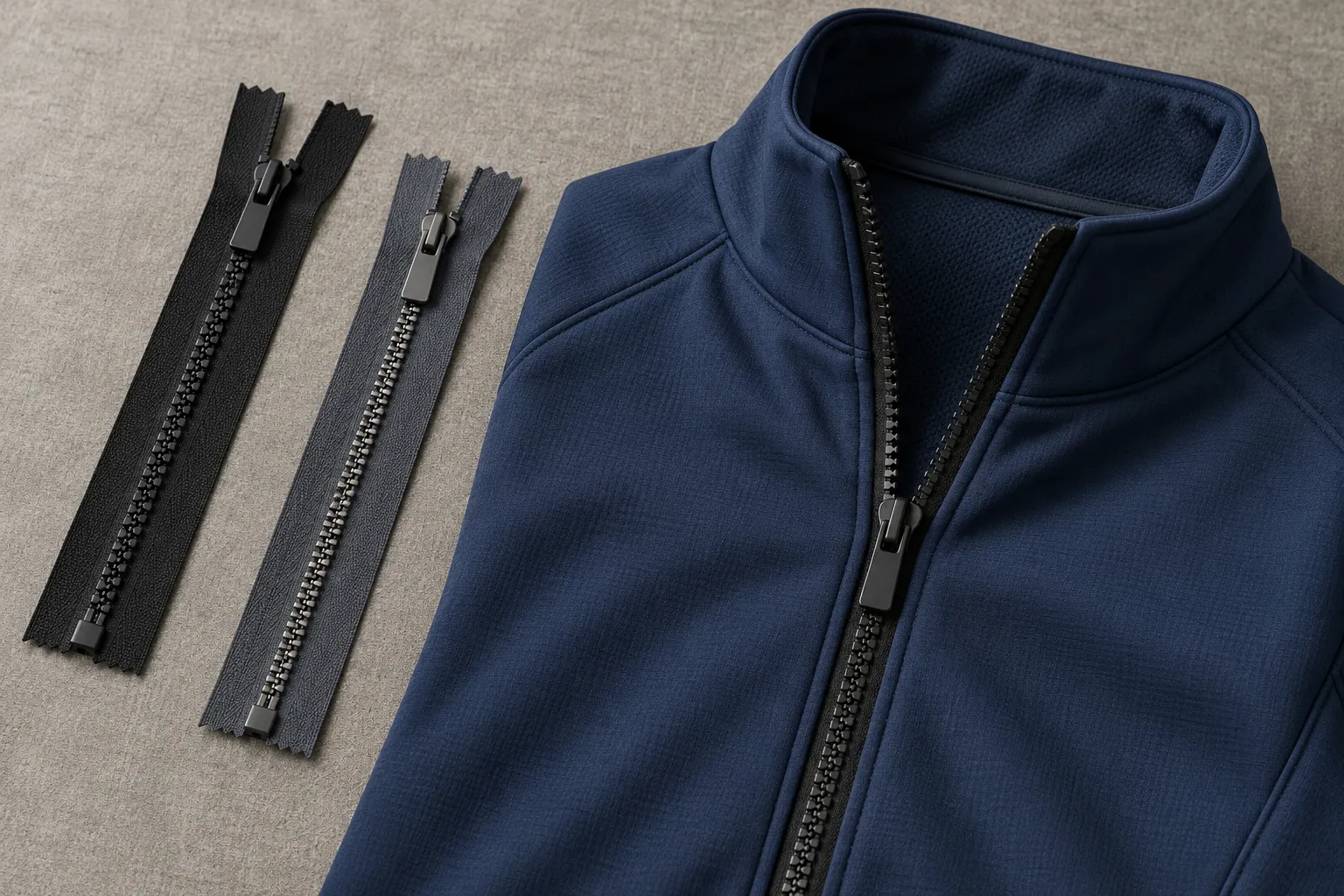
Short Answer
To specify a sportswear jacket zipper, define how the front must open, identify the chain and slider, agree the length measurement method, and check the selected component in the intended garment. The chain is the interlocking row of teeth or coils; the slider is the moving part that opens and closes it. A photograph or a size number alone leaves important decisions unresolved, so record a supplier reference and review the assembled sample before bulk approval.
1. Describe the opening before choosing the appearance
Start with the wearer’s task. Should the jacket open completely at the front, stay joined at the bottom, or also open upward from the hem? Write that function in plain language before discussing colour or a decorative puller.
YKK’s product classification guide distinguishes a separating zipper, whose sides come apart, from a two-way separating zipper that also opens from below. For an ordinary fully opening jacket, request the separating function. A partial neck opening has a different requirement.
Show the intended direction of operation on the garment sketch. If insertion side matters, identify it from the wearer’s perspective and confirm it on a physical sample. Avoid relying on “left zipper” without a drawing or explanation of what left means.
Keep this decision within the whole product brief. Our retro track-jacket development guide covers silhouette, panels and fit. Here the task is narrower: specifying the front closure so a component supplier and sewing team can identify the same item.
2. Request an identifiable chain and size
Ask the supplier to propose a named product family and size for the fabric, opening and intended use. Coil, moulded plastic and metal chains are different constructions. Review actual samples rather than assuming that the most substantial-looking option is best for every jacket.
YKK’s size explanation relates its size numbers to chain width. A size number is therefore not the zipper length, and it does not by itself identify the material, slider, finish or product reference. Record the complete proposed component.
Put samples beside the intended shell fabric, the garment’s outer fabric, and handle them together. Is the visible chain consistent with the design? Does the sample give you the desired front appearance when closed? Ask the supplier to confirm suitability rather than using a visual preference as proof of performance.
Current trim development also needs careful scope. In its 13 July 2026 announcement, YKK described a concept zipper using nonwoven tape partially derived from used clothing for a couture collection. This is evidence of material innovation, not proof that the concept is available for your sportswear order. Request a commercially available reference and supporting information for any proposed special material.
3. Specify the slider separately from the puller
The puller is the tab the wearer holds. Its shape is only one part of the decision: the slider body also has to perform the required function. Ask the supplier to state the slider reference and locking behaviour alongside the chain reference.
YKK Japan’s FAQ recommends an automatic slider for outerwear fronts and warns that a notch-lock type can slide down in that use. Confirm the appropriate configuration for the actual product instead of approving a puller photograph as approval of the complete slider.
If the jacket will be used with gloves
Include the intended gloves in the sample review. Ask the wearer to start the zipper, grasp the tab and close the jacket without changing the task midway. Record whether the difficulty is gripping the puller or inserting the separating end; these need different investigations.
If two-way opening is requested
Demonstrate both opening directions and complete separation on the sample. Ask the supplier for the correct operating instructions. Do not assume that adding a second slider to another component produces the requested two-way separating construction.
4. Agree the length method and each garment-size requirement
Give the component supplier a marked sketch showing the intended top and bottom positions in the jacket. Then confirm how its ordered zipper length is measured. Tape extensions used for sewing are not automatically the same dimension as the product length.
YKK’s dimension guide shows different measurement endpoints for different zipper configurations. Use the method for the selected product. Record the units, endpoints and agreed tolerance, meaning the permitted variation, rather than copying a measurement from an unidentified loose zipper.
List the required component length for each garment size, or explicitly record where one length is shared. If body length changes during fit development, check the front opening again before ordering components. Do not assume every size takes the base-size zipper or that every size needs a different one.
Ask which dimensions remain open and who will resolve them. The pattern maker may need to confirm the opening before the component order can be final. Keep the final values with the factory-ready tech pack, the document defining the garment, so the order and pattern do not use different versions.
5. Use a worked brief to expose missing decisions
Consider this hypothetical adult training jacket: navy knit shell, a fully opening front, one slider and a plain black puller. The design team wants a discreet closure and has not requested a weather-protection claim. These details describe an example, not an S & H Global product or standard.
A useful initial request would read: “Please propose a coil zipper suitable for this adult knit jacket, separating at the hem, with an automatic-lock slider and plain puller. Supply the complete product and slider references. Confirm length measurement endpoints against the attached front-opening sketch, then quote the agreed length schedule by garment size.”
Notice what remains open: the exact chain size, length schedule and confirmed supplier references. Mark those as decisions to resolve, not approved values. Once selected, add the tape colour reference, exposed-chain appearance, slider finish and approved component sample identity.
If the supplier proposes a moulded chain instead, request the reason and compare it in the garment. A change in construction is a proposal requiring a decision. This brief makes alternatives visible without pretending the buyer already knows every catalogue code.
6. Diagnose operation in the sewn jacket
Test the actual assembly. YKK Malaysia’s FAQ explains that stitching too close to the chain can restrict the slider or cause catching, and that thin or soft fabric may need reinforcement. A loose zipper that operates well has not answered the installation question.
YKK’s sewing guidance also calls for room around the slider and recommends checking long zippers in the garment before final sewing, particularly with knits. Ask the technical team to assess the construction; do not prescribe an unsupported universal stitch distance.
If it catches, identify the location and whether shell, lining or another part enters the slider. If the slider moves but the front looks distorted, ask the team to review the assembly and fit. Do not immediately replace the zipper with a larger size as a cure for every problem.
Include ordinary intended movements in the review and record the condition in which an issue occurs. Rab’s zip-care guidance warns against forcing a jammed zipper. Stop and investigate a catch rather than pulling harder to make the sample pass.
7. Close the component decision before releasing bulk
Review the assembled garment after the agreed care procedure and record appearance and operation. Ask the supplier which care and finishing conditions the selected component supports. Product-specific test methods and acceptance limits should be agreed with the technical team; a few successful openings do not establish a durability claim.
Keep one component record containing the final references, function, size, length schedule, colours, finish, care requirements and approved sample identity. Check that the purchase specification matches it. If a substitute is proposed later, identify which decisions and garment checks need repeating.
For development with S & H Global, share your sportswear requirements and send the garment brief, intended fabric and closure sketch. Confirm which component options and checks can be supported for your order. A supplier catalogue mentioned here does not imply an S & H Global brand partnership or guaranteed stock availability.
Related resources
Continue planning
Read next